
|
 the
Hive BB the
Hive BB  Crystal
Meth Crystal
Meth  continuation
of Wizard x's "One Step" thread continuation
of Wizard x's "One Step" thread
|
| next newest topic | next oldest topic |
| Author | Topic: continuation of Wizard x's "One Step" thread |
| dwarfer Member |
 posted 09-20-1999 03:49 PM

I tried to post to the referenced thread but it would accept no more messages. ?? Anyway, my understanding of the bubbling of the H2S is to generate SO3 radical. H2S has its share of hazards in use and smell. COULD Na thiosulfate, which generates .....S2O3->SO3 + S.......... be produced IN the mixture through gradual acidification, or, perhaps through electrolytic means? If so, and if pressurization would be an asset to the effectiveness of the process, this could be the cat's meow, or the molasses' revenge: easy for me to get excited: in my mind it works perfectly, being unconstrained by nuisance considerations of chemical minutia. Might need a particular anode: might need a 1/2 cell: might need good agitation. Might be ridiculous. I oughta change my name to "slap me if I need it" for these far out what if posts. dwarfer |
| dwarfer Member |
posted 09-20-1999 04:02 PM
Here's some names I tried to open that were "allready taken"!! (Hard to believe!) "OK, I'm a dumb shit" Oh well: I tried |
| Hematite Member |
posted 09-21-1999 12:11 PM
Dwarfer, I know exactly what you mean. It always makes me laugh at how we attach so many of our human emotions to our deliberately invented anonymous posting names. Ps. If your real name is Dwarfer, then Hematite most humbly apologises. PPs. Apologises for your parents cruelty that is 
------------------ |
| dwarfer Member |
posted 09-21-1999 08:01 PM
Yeah, it's a surprise to me to note the attachment you get after a while to a stupid name. i made up dwarfer on the spur of the minute, since I WAS posting under my name when I first started: soon realized that was not tooooooooooooooo smart, so went to register and "dwarfer" popped up. Hell, if I thought about it I woulda picked "Petunia" or something
sweet and nice like I am, really! Now if I could JUST get Wiz or Rev. to comment on the thiosulphate idea. I'm willing to experiment if the idea is not TOO ludicrous: but do not want to waste my time if its obviously a non-runner. hey THHHHHHpitterdude(dodge the spray): howabout using your not inconsiderable influence with the Reverend to inveigle him into critiqueing this possibility?? TTTHHHHHHanx! dwarfer |
| Overlord Junior Member |
posted 09-21-1999 09:44 PM
bad wiz... you are bad
|
| Wizard
X Member |
posted 09-23-1999 02:37 AM
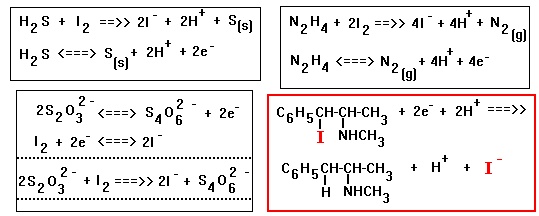
The quantitative conversion of the thiosulphate, S2O3(-2) ion to tetrathionate, S4O6(-2) ion is unique with iodine, I2; OTHER oxidizing agents Cl2 and Br2, tend to carry the oxidation further, to sulphate ions or a mixture of sulphate ions and tetrathionate ions. The thiosulphate, S2O3(-2) ion tend to decompose to give sulphur and
hydrogen sulphite ion: S2O3(-2) + H(+) <==> HSO3(-) + S I believe addition of thiosulphate, S2O3(-2) to iodoephedrine will result in dimerization of the iodoephedrine, due to radical formation and coupling. The thiosulphate, S2O3(-2) will release 2 electrons, BUT NO protons H(+) to react with the I(-) ion formed and the C6H5-CH(..)-CH(NHCH3)-CH3 radical anion formed. Hydrogen sulphide, H2S and Hydrazine, N2H4 will release electrons and protons for the reduction of iodoephedrine. C6H5-CH(I)-CH(NHCH3)-CH3 + H2S ==>> C6H5-CH2-CH(NHCH3)-CH3 + S + HI 2 C6H5-CH(I)-CH(NHCH3)-CH3 + N2H4 ==>> |
| Worlock Member |
posted 09-23-1999 03:02 PM
The Sodium thiosulfate does seem to clear the redness from the final acidic solution in the HI/RP solution because as the Sodium thiosulfate hits the acid it initially will ionize into Na+ and thiosulfate. The Na+ and the I- form [Na+ I-] which eliminates the color. Then as Wizard-x notes in detail the thiosulfate degenerates. Once again then I return to the question of why use Sodium thiosulfate to clear the iodide out of the finished reaction mixture. Because as soon as the alkalizing begins with Sodium hydroxide the same
thing happens the Na+ ionizes then hooks up with I- to form To cap this off with my final thrust at I2, realise that in an Acidic Solution the existance of I2 is highly dubious. |
| Wizard
X Member |
posted 09-23-1999 07:25 PM
Worlock : "Once again then I return to the question of why use Sodium thiosulfate to clear the iodide out of the finished reaction mixture". To convert the I2 into a soluble ion I(-) so you do not solvent extract I2 when you extract your final product. |
| Fitzhugh Member |
posted 10-10-1999 04:47 AM
Wizard X The way I read the hydrazine reaction would mean that I would add one half of a mole of N2H4 for every mole of I2 to produce the initial HI, and I would add one-half of a mole of N2H4 for every mole of p/efed to remove the I and replace it with an H, and regenerate the HI. This process looks like it would generate H2O as well. Have you a suggestion for actually running this reaction? Combine ingredients in the proper ratios with a minimum of water and reflux for a long time? A short time? This sounds too interesting to ignore. |
| Wizard
X Member |
posted 10-10-1999 07:40 PM
If you want to make iodoephedrine first you add 1 mole of hydrazine N2H4 : 4 moles of iodine to make 4 moles of HI, and then you add 2 moles of ephedrine. Refluxing this for approx 24 hours gives iodoephedrine. Then 2 moles of iodoephedrine : 1.1 moles of hydrazine. The other method is to reduce 1 moles of ephedrine with 2 moles of hydrazine. |
| Fitzhugh Member |
posted 10-14-1999 07:30 AM
If one were willing to dream of testing some variations of the E + N2H4 method you mention, would you have any suggestions for initial conditions, reaction temperatures or durations? (I know that N2H4 reacts more strongly at higher temperatures.) The generation on N2 gas would be an indicator of the reaction's progress. -- Fitzhugh-- |
| whoops Member |
posted 11-13-1999 05:11 PM
once again rephrase the method or question? Dont everybody understand the removal point being considered by making
the freebase ya are removing the Haloid from the mixture and it is gona co
[do not miss this is not a typo idiot]Carbon monoxide is formed from the
classical, or shall we also consider the solvent burning or well we could
complicate this further by discussing the phosphor,,,NO THANKS IT AN ODD CHARGE AINT IT??????? ---Amethystium--- |
|
All times are CT (US) |
next newest topic | next oldest topic |
 
|
|
Contact Us | the Hive
Powered by: Ultimate Bulletin Board, Version 5.39a
© Infopop Corporation
(formerly Madrona Park, Inc.), 1998 -
1999.